
You’re speeding 30 over the limit down the information superhighway when a billboard distracts you. Slamming the brakes, you swerve into a crowd of people gathered at its base. Most jump out of the way as you screech to a stop, but you wing a few for sure. There appears to be somebody on the billboard itself looking down at the crowd. You roll down your window for some air and remark under your breath:
“Oh this looks nice”
You immediately clock a side eye from a nearby someone and the world freezes. After a beat, 4 men in vaguely cartoon masks start shouting at you.
“It’s tasteless trash!” “Woooooow, you would like this” “Worst take I ever heard” “Really?? Simp.” “You fucking idiot can’t you tell this is just a rip off of—”
You peel out and in the rear view mirror you think you see the person on the billboard sigh.
The internet is in goblin mode.
You can feel it just underneath the surface of every conversation. There’s a nuclear-grade reactivity baked in. There’s a latent frustration with what’s happening, how it’s happening, and who’s doing the happening, whatever the happening may be.
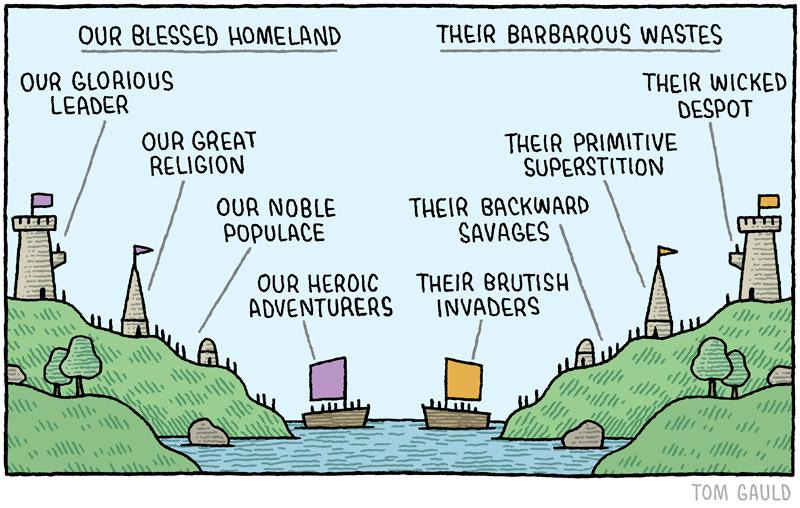
Even if your team is winning the Current Thing today, there’s always some part of your body clenching because no matter what the villainous other side still exists. They stare at you haughtily from the other side of the valley. They gnash their teeth as you gnash yours. And somehow this condition afflicts the optimists and the pessimists, the accelerationists and anti-accelerationists, the rationalists, the anti-snowflake, and the snowflake alike.
There’s an almost frantic quality to even the most measured takes right now. Every society defining victory of progress is tinged with the spectre of a permanent underclass. Every setback is proof of doom positive.
I grew up in a different internet.
It certainly had hate, but it had joy too. And much of the hate was relegated to the toxic waste dumps to self-percolate and giga-ironize in a relatively acceptable-to-the-rest-of-internet-society energy containment field. Sure, it’d breach containment every once in a while, but back then it was almost fun when it happened.
There was something else out there on the internet that I’ve missed. It wasn’t quite as straightforward as collaboration nor as sacred as communion. It was something that I think I can only describe as fellowship.
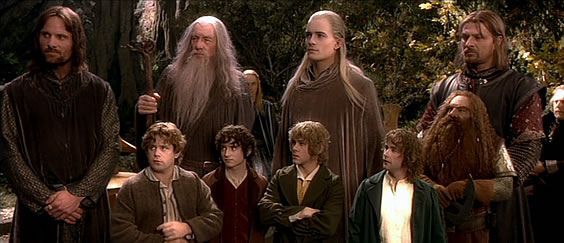
Wherever you went online, you could rest by a passing campfire and start to see the arc of something happening. Maybe it was the birth of a thesis about an important event or perhaps it was just shared enjoyment of a goofy flash animation, but no matter what it was there were these public pockets where you’d hang out and watch or even participate in the thing as it was happening. This quasi-anonymous fellowship is what made me and many others of my generation fall in love with the internet in the first place.
Thankfully, this fellowship still exists, but its DNA is different.
It’s balkanized. It’s underground. It’s moved to the quiet, siloed places like other people smarter than me have written about before.
Just like the European Resistance during WWII, pockets of culture and goodness still quietly smolder in groupchats and hard-to-find discords as the blitzkrieg storms across the vast digital countryside. There’s probably at least one good Slack instance out there too.
But the sad reality of resistance warfare is clandestine systems, low trust of outsiders, and guarding your walls (to the death if needed). The French resistance survived because it was designed to be unknowable from the outside. Its small cells and lack of central ledger meant that if one Maquis fell, the others survived to fight another day.
Across human history, we see this kind of cultural defense emerge crab-like from the frothing frontlines of cognitive (and actual) warfare. As Rome collapsed in 476 AD and literacy in Europe slowly starved to death from neglect, monks carried texts to Skellig Michael, the Vivarium, and a few other of the most geographically inconvenient places they could find to keep writing anyway. Over the following centuries they walked back out through the continent in waves to reseed the art and science of literature. Well before Hulagu Khan sacked Baghdad's libraries in 1258, the natural fragmentation of the Caliphate had already pulled the Islamic thinking class outward across the Islamic world, likely saving it from total destruction. Even as recently as the Cold War, networks of dissidents in Moscow, Prague, and Warsaw built samizdat. Their shadow publishing system of carbon copy manuscripts spread hand to hand helped lay the institutional groundwork for the governments that would step up after the fall of the Soviet Union.
It’s a different conflict now with different corporate, state, and chaotic actors with different incentives, but it’s the same conflict really, and the strategy to survive it is largely the same.
Goblin mode is having its day, but the pockets of ideas and people and culture that will lay the foundation for the next evolution of that lost fellowship are already forming.