
My son has some skin issues right now. It’s not the end of the world (yet), but his skin is dry and scratchy and, in the middle of Boston winter, it’s certainly not a fun experience for a 5-month-old. Fortunately, he’s still in good spirits.
We’ve been to a few doctor’s appointments about it ($150 per visit). We got the standard advice of lotion and vaseline and baths without soap and to switch up the laundry detergent and the like. After little improvement and some persistence on our part, we eventually got a referral for an allergist to check if he’s allergic to anything.
The allergist (bill pending) runs their test and says he doesn’t have allergies. Great.
The allergist also prescribes a cream for us to put on daily. It turns out babies need help with their skin sometimes because babies have baby skin.
It’s new skin. It’s sensitive. Makes sense.
Later that evening, we call the pharmacy to check on the prescription.
It’ll be ready tomorrow morning (great) and ah unfortunately sir it will be $765 for one tube of the cream.
Great.
We ask if there’s any coupons they can apply. He says good news there is! The new price for one tube of cream is now $715.
Dissociating slightly, I ask to double check if they applied our insurance ($2,000 per month).
He says yes.
Defeated, we ask if there’s anything else we can do to reduce the price. He says to look online for a deal with GoodRx and get back to him. He hangs up.
We’ve been here before.
GoodRx is a discount drug platform that exists because there is no “real” price for medication. Every party in the medicinal supply chain pays something different depending on their relationship to the manufacturer, their negotiating abilities, and the intermediaries between you and the medicine. For a long time, organizations called Pharmacy Benefit Managers (PBMs) negotiated with drug manufacturers directly on behalf of groups of insurance companies. This genuinely helped with some aspects of price negotiations through collective bargaining, but also outsourced drug expertise, diffused culpability for high insurance copays, and created conflicting incentives within the healthcare industry. It also lets PBMs earn a vig by deciding which medications become the default prescription for various illnesses, giving them significant leverage over both pharmacies and drug manufacturers.
Insurance companies have a variety of concerns they think about when dealing with PBMs and drug manufacturers. Only some of those concerns involve getting the lowest drug prices possible for plan holders. GoodRx understands this, negotiates its own prices with the PBMs and other parties in the drug supply chain, and sometimes the price they negotiate is gonna be better than what you could get with your insurance.
Importantly, GoodRx is not your insurance.
This means anything you pay to them typically does not go towards your deductible. So using GoodRx often helps in the short term by reducing your immediate drug costs, but this benefit may come at the expense of a higher overall yearly medical bill since you’re not actually paying down your deductible. Whether GoodRx is good or bad for your situation mostly depends on your medical luck for the rest of the deductible period.
Basically, GoodRx is an industry workaround that became a business.
Anyway, we check GoodRx. We find a deal. The cream we’re supposed to put on baby every day, perhaps for the rest of his childhood, can now be purchased for the low, low price of $208 a tube (list price: $957.09).
Wincing at the napkin math, we call the allergist to see if there are any other options.
She’s curt (dare I say gruff?) on the phone.
“There’s no generic and there’s nothing else like it for babies that young. He needs the cream.”
Okay. Fine. We’ll figure out the budget.
Just before we pull the trigger on this tube that costs its weight in silver, my wife remembered something. A few years ago she was prescribed a drug that, after our insurance, came out to about $3,500 per bottle. She’d almost foregone that course of treatment until a friend in the medical industry recommended we check to see if the manufacturer offered something called a “Copay Card”.
Drug manufacturers aren’t dumb. They know when they price their medications stupidly high. They often do this as a deliberate tactic to anchor price negotiations waaaaay up there, then sweet talk the PBMs and the insurers by offering dramatic rebates on the strategically inflated prices. This lets the manufacturers look generous to their counterparties and lets the PBMs show the insurers how much money they’re “saving” them and lets insurers report how much money they’re “saving” their patients.
When an insurer doesn’t get a rebate or won’t cover a medication, everybody in the chain knows that patients get sticker shock. They may even skip filling the prescription altogether. So, in order to close that crucial initial sale and establish a customer’s treatment habits, drug manufacturers will sometimes offer patients a special drug price directly via a “Copay Card” mechanism. This special price is usually temporary as Copay card usage is typically capped after a certain amount of dollars “saved” by the patient so they will eventually pay the high prices.
Of course, it’s also hit or miss if the copay card cost counts towards your deductible.
In my wife’s case, the copay card brought her drug price down to a much more manageable $35. The savings cap lasted for about 5 months worth of refills. Coincidentally, this is also how long she decided to take this medication before switching to something more affordable.
So we look for a copay card for this cream and, sure enough, one exists.
The copay card brings this $957 tube of skin cream down to $10.
That’s a 99% reduction in price that we only got because we knew to look for it.
It makes me wonder how many harried people are too busy to do anything but scramble to scrape together $957 or $765 or $208.
Or, more likely, how many skip their prescriptions entirely?
The reality is that there’s a war between titans that we, the patients, are mostly unaware of. It’s a war over dollars fought through the vehicle of health. On one side are the insurers and PBMs, or vertically integrated combinations like CVS Health, optimizing for low healthcare payouts and high pricing spreads; on the other side are drug manufacturers like Pfizer, optimizing for their drugs to be used as widely and as long as possible. These incentives collide to create capricious pricing problems and odd solutions.
CVS Health made $4.6B in net income last year. Pfizer made $8B.
It feels insane, but this system works pretty much how every party (except one) wants it to.
When push comes to shove, of course you squeeze the patient.
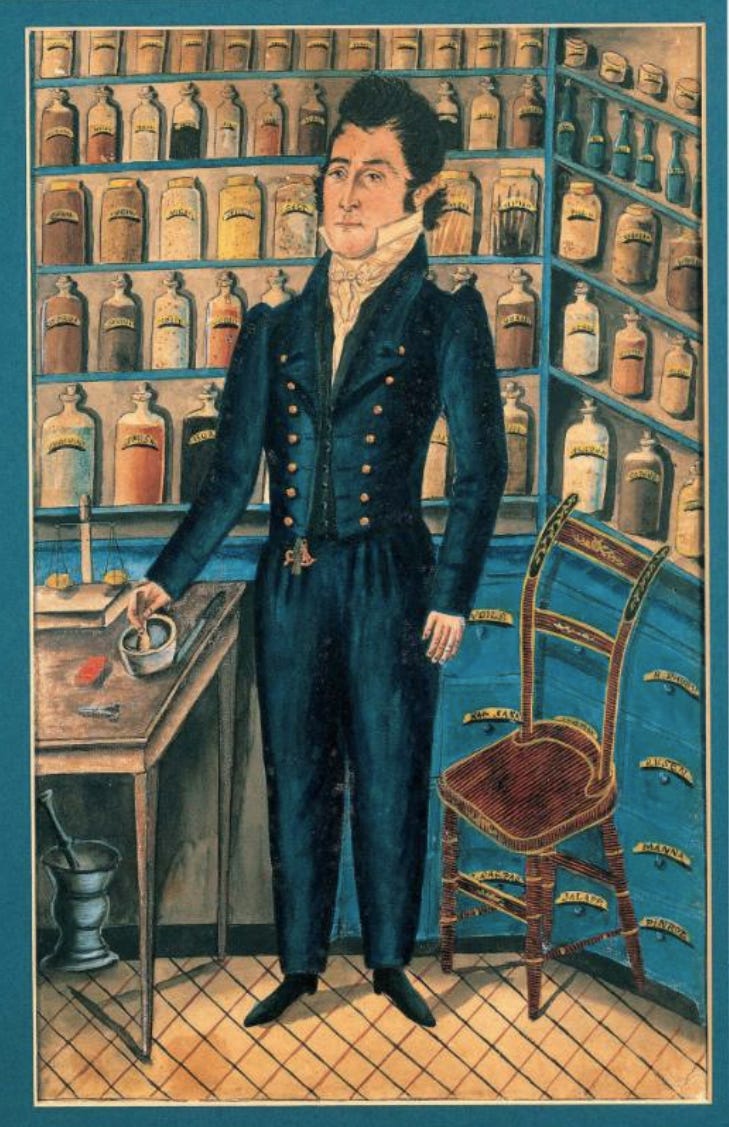
Cover: Jacob Maentel, Dr. Christian Bucher (1830)
Right on man
I rarely read anything that comes into my inbox lately but this had me glued to the screen. Thanks so much for sharing this. I know all about this nonsense because my late mother worked for a managed care company as a go-between for doctors and insurance companies, trying to make sure everyone was getting paid what they should. She even did some investigative work at one point and I went with her and we had to covertly get doctors to sign off on us looking through their records and we’re be on the floor in the file room after hours and stuff trying to prove fraud and such.
These days I opt out of pharma altogether in every possible way. In your situation though, I would have wanted that cream, too. Wow. You two did amazing work!!! This is great writing!!!